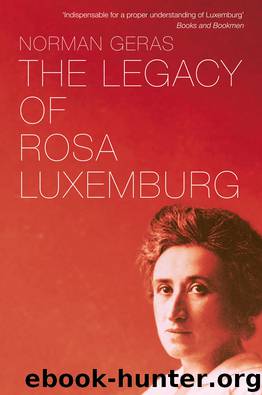
The Legacy of Rosa Luxemburg by Norman Geras
Author:Norman Geras
Language: eng
Format: epub
Publisher: Verso Books
Published: 2015-06-16T04:00:00+00:00
III
The Mass Strike
‘The masses are the decisive factor; they are the rock upon which the final victory of the revolution is erected.’1
Rosa Luxemburg laid great emphasis on the spontaneity of the masses. Those who know anything about her are likely to know at least that. They are unlikely to have seen any connection between it and the fact that she was a woman. But this connection has been made. The late George Lichtheim, after drawing attention to the contrast between her revolutionary positions and the reformism of E. D. Kuskova, authoress of the ‘economist’ Credo, went on to say: ‘This suggests that their shared reliance on “spontaneity” against “consciousness” may have had psychological roots. At any rate there is the fact that both were women, and that Luxemburg throughout her career gave the impression of regarding conscious control as a threat to spontaneity – a typically feminine notion.’2 The suggestion, surprising though it may be, coheres quite well with the widespread tendency to locate the source of Luxemburg’s attitude towards the masses somewhere beyond or beneath the realm of rational discourse. The consensus about this amongst serious scholars extends even into the terminology by which they characterise her. Thus, C. Wright Mills spoke of the ‘labour metaphysic’ as being for Rosa Luxemburg ‘both a final fact and an ultimate faith’. According to E. H. Carr she had ‘a fanatical but utopian, almost anarchist, faith in the masses’, and according to F. L. Carsten, a ‘blind faith in the masses’. Lichtheim himself identified in her politics ‘a species of Syndicalist romanticism’, referring also to her ‘vague faith in “the masses” ’ and to ‘her mystical doctrine of loyalty to the proletariat’.3 The language is uniform in evoking the image of some religious zealot.
The assessment offered by these writers is not wholly negative. They concur, for example, in pointing to the moral, humanitarian and democratic aspects of Luxemburg’s thought. With this there is no need to quarrel – only provided one bears in mind her explicit rejection of the idea that, while classes continue to exist, there could be a classless morality or democracy.4 She did spend a lifetime fighting against what she once termed ‘the profoundest of immoralities’, namely, exploitation,5 and fighting for the proletarian democracy which would liquidate it. A deeply humanitarian impulse is transparent throughout her work. However, to place on the positive side of any balance sheet only her uncompromising commitment to these values is to damn her with faint praise. In her orientation towards the masses there was also a broad strategic insight of the utmost realism. The importance of Rosa Luxemburg resides equally in that.
* * *
We can define the problem that confronted Rosa Luxemburg as a revolutionary militant inside German Social Democracy before the First World War, by reference to the distinction in the party’s programme between the minimum and the maximum demands: on the one hand, a set of demands responding to the immediate, everyday concerns of the masses and which could be realised within the framework of capitalist society; on the other hand, ultimate socialist objectives.
Download
This site does not store any files on its server. We only index and link to content provided by other sites. Please contact the content providers to delete copyright contents if any and email us, we'll remove relevant links or contents immediately.
| Anthropology | Archaeology |
| Philosophy | Politics & Government |
| Social Sciences | Sociology |
| Women's Studies |
The Secret History by Donna Tartt(19311)
The Social Justice Warrior Handbook by Lisa De Pasquale(12227)
Thirteen Reasons Why by Jay Asher(9005)
This Is How You Lose Her by Junot Diaz(6962)
Weapons of Math Destruction by Cathy O'Neil(6371)
Zero to One by Peter Thiel(5874)
Beartown by Fredrik Backman(5846)
The Myth of the Strong Leader by Archie Brown(5552)
The Fire Next Time by James Baldwin(5508)
How Democracies Die by Steven Levitsky & Daniel Ziblatt(5276)
Promise Me, Dad by Joe Biden(5192)
Stone's Rules by Roger Stone(5133)
A Higher Loyalty: Truth, Lies, and Leadership by James Comey(5020)
100 Deadly Skills by Clint Emerson(4975)
Rise and Kill First by Ronen Bergman(4840)
Secrecy World by Jake Bernstein(4804)
The David Icke Guide to the Global Conspiracy (and how to end it) by David Icke(4775)
The Doomsday Machine by Daniel Ellsberg(4557)
The Farm by Tom Rob Smith(4555)
